
Intel vs AMD (2026) – Which Processor Should You Choose? ⚔️
Intel vs AMD (2026) is one of the biggest decisions you’ll make when buying a laptop—and most people get it wrong.
They see:
- “Intel i5” or “Ryzen 5”
- Assume both are similar
- Buy without understanding performance
👉 That’s how people end up with slow laptops.
The truth is:
- Both Intel and AMD are powerful
- But they excel in different areas
- Choosing the wrong one = wasted money
📑 Table of Contents
Intel vs AMD (2026): The Real Difference 🧠
At a basic level:
- Intel focuses on speed and responsiveness
- AMD focuses on efficiency and multitasking
But in 2026, the gap is much closer than before.
According to recent benchmarks, AMD leads in overall efficiency and gaming performance in many cases, while Intel still dominates single-core tasks and certain workloads. :contentReference[oaicite:0]{index=0}
👉 Translation:
- Intel = faster for quick tasks
- AMD = better for heavy multitasking
Intel vs AMD (2026): Performance Breakdown ⚡
Performance is where most buyers get confused.
🧠 Single-Core Performance
This affects:
- App loading speed
- System responsiveness
- Light tasks
👉 Intel generally leads here due to higher clock speeds and hybrid architecture. :contentReference[oaicite:1]{index=1}
—🚀 Multi-Core Performance
This affects:
- Multitasking
- Video editing
- Heavy workloads
👉 AMD usually performs better because it offers more cores at similar prices. :contentReference[oaicite:2]{index=2}
—So:
- Intel → faster in short bursts
- AMD → stronger in long workloads
Intel vs AMD (2026): Multitasking & Efficiency 🔋
This is where AMD shines.
AMD processors are known for:
- Better performance per watt
- Lower power consumption
- Stronger efficiency
In modern laptops, AMD chips often deliver better battery efficiency depending on design. :contentReference[oaicite:3]{index=3}
👉 Important:
Battery life is not just CPU—it depends on laptop design too. :contentReference[oaicite:4]{index=4}
—Intel vs AMD (2026): Gaming Performance 🎮
Gaming used to be Intel’s territory.
Not anymore.
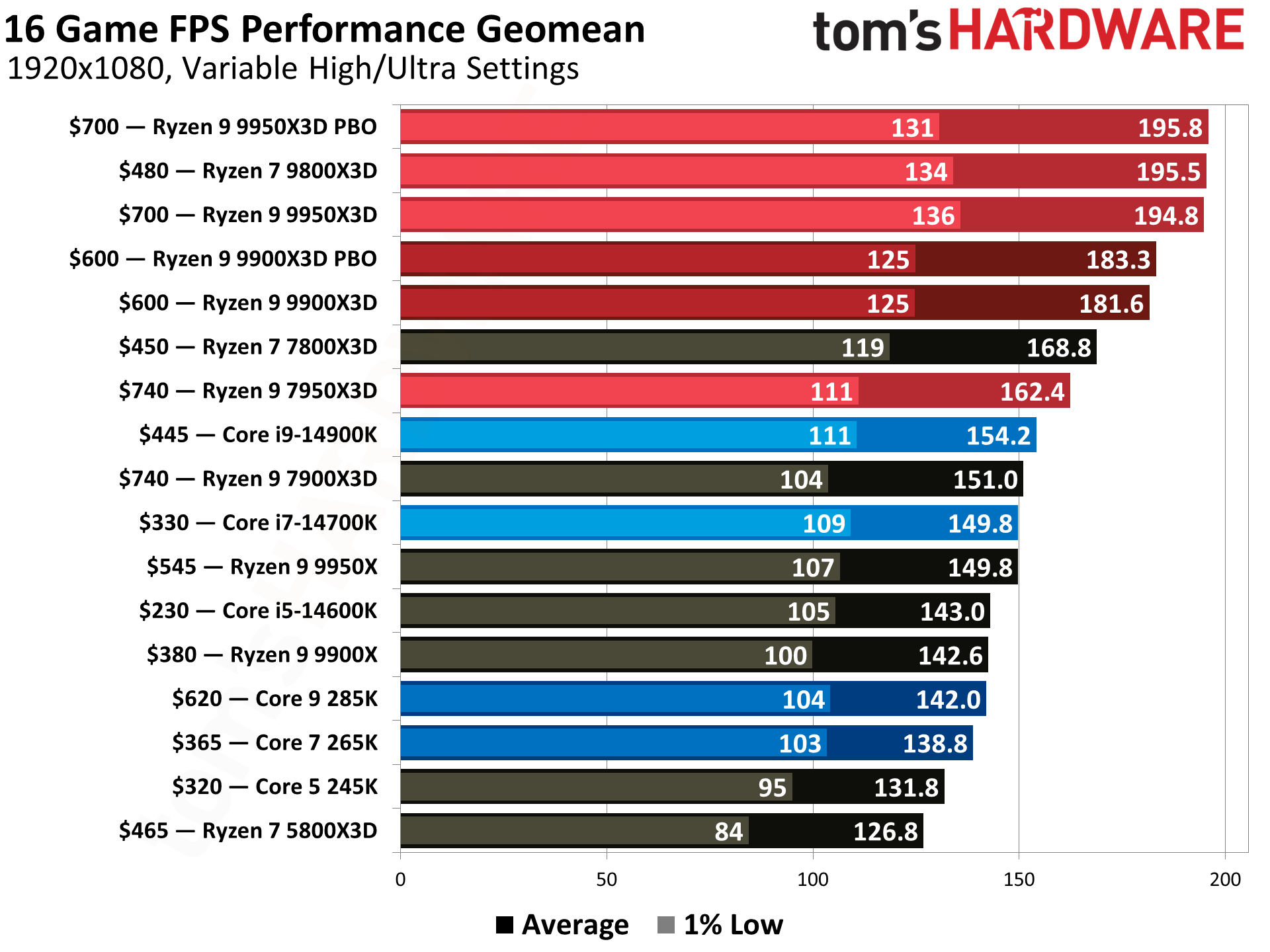
AMD’s latest Ryzen processors with 3D V-Cache are now dominating gaming benchmarks in many cases. :contentReference[oaicite:5]{index=5}
👉 What this means:
- AMD = better FPS (in many games)
- Intel = still strong, especially mid-range
🔗 Related Guides
Intel vs AMD (2026): Battery Life & Efficiency 🔋
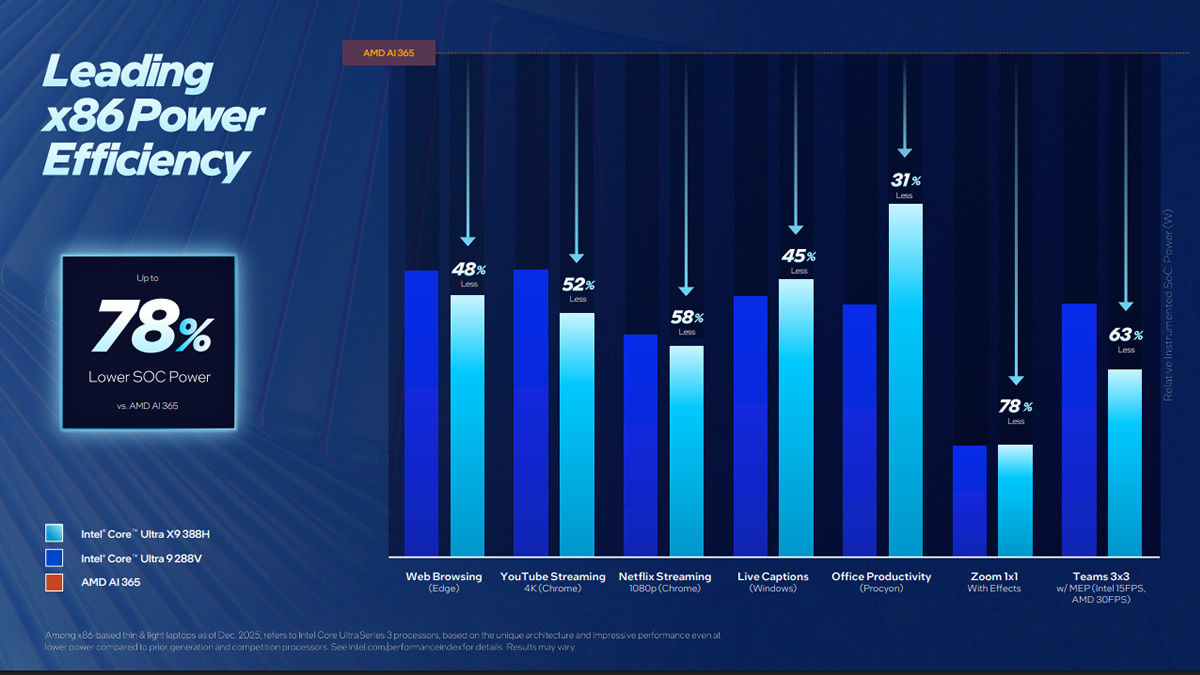
Battery life is one of the most misunderstood areas when comparing processors.
Most people assume:
- AMD = always better battery
- Intel = always worse battery
👉 That’s not entirely true.
⚡ Reality Check
- AMD → More efficient in sustained workloads
- Intel → Improved significantly with hybrid architecture
Modern Intel chips use:
- Performance cores (for heavy tasks)
- Efficiency cores (for background tasks)
👉 Result: Better battery optimization than older generations.
But:
- AMD still leads in many thin & light laptops
- Battery also depends on laptop design, not just CPU
Intel vs AMD (2026): Integrated Graphics Performance 🎮

If you’re not using a dedicated GPU, this section matters a lot.
🧠 AMD Integrated Graphics (Radeon)
- Stronger gaming performance
- Better for casual gaming
- Handles creative tasks better
⚡ Intel Integrated Graphics (Iris Xe / UHD)
- Good for everyday use
- Improved over older generations
- Still behind AMD in gaming
👉 Verdict:
- AMD = better for gaming without GPU
- Intel = fine for normal use
Intel vs AMD (2026): Heat & Thermal Performance 🌡️
Performance means nothing if your laptop overheats.
This is where real-world usage matters more than specs.
🔥 Intel
- Higher peak performance
- Can generate more heat under load
❄️ AMD
- More efficient in sustained tasks
- Generally runs cooler in similar configurations
👉 Important:
Thermal performance depends heavily on the laptop’s cooling system—not just CPU brand.
—Intel vs AMD (2026): Price-to-Performance 💰
This is where AMD usually wins.
💸 AMD Advantage
- More cores at similar price
- Better multitasking performance
- Strong integrated graphics
⚖️ Intel Advantage
- Better optimization in some apps
- Stronger single-core performance
- Wider availability in laptops
👉 Real-world takeaway:
- AMD = better value in many cases
- Intel = better for specific use cases
Intel vs AMD (2026): Which One Should YOU Choose? 🎯
Let’s simplify this completely.
👉 Choose Intel if you:
- Want faster responsiveness
- Use apps optimized for Intel
- Prefer stable performance across tasks
👉 Choose AMD if you:
- Want better value for money
- Do heavy multitasking
- Play games without dedicated GPU
👉 There is no universal winner.
The best processor depends on your usage.
—🔗 Related Guides
Intel vs AMD (2026): Direct CPU Comparisons ⚔️
Let’s remove confusion completely by comparing equivalent processors.
🧠 Intel i3 vs Ryzen 3
- Intel i3 → Better single-core speed
- Ryzen 3 → Better multitasking
👉 Winner: Depends on usage (Intel for speed, AMD for balance)
—⚡ Intel i5 vs Ryzen 5
- Intel i5 → Faster responsiveness
- Ryzen 5 → More cores, better multitasking
👉 Winner: AMD for value, Intel for responsiveness
—🚀 Intel i7 vs Ryzen 7
- Intel i7 → Strong high-performance bursts
- Ryzen 7 → Better sustained performance
👉 Winner: AMD for heavy workloads
—Intel vs AMD (2026): Final Recommendation 🎯
If you don’t want to overthink, follow this:
- 👉 Students / Basic Users → Either (choose best deal)
- 👉 Office / Productivity → Intel i5 or Ryzen 5
- 👉 Gaming (no GPU) → AMD Ryzen
- 👉 Heavy Work (editing, coding) → AMD Ryzen 5 / 7
👉 For most users in India, Ryzen 5 and Intel i5 are the sweet spot.
—Intel vs AMD (2026): Biggest Myths You Should Ignore 🚫
❌ Myth 1: Intel is always better
Not true anymore. AMD has caught up and often leads in value and multitasking.
❌ Myth 2: AMD overheats more
Modern AMD chips are efficient and often run cooler in many laptops.
❌ Myth 3: AMD is only for gaming
AMD is excellent for productivity and professional workloads too.
❌ Myth 4: Higher number = better performance
Generation matters more than just “i5” or “Ryzen 5”.
—🏆 Final Verdict: Intel vs AMD (2026)
Here’s the truth—there is no universal winner.
Both Intel and AMD are excellent in 2026.
The difference is:
- Intel → Better responsiveness
- AMD → Better value & multitasking
👉 If you choose based on your usage, you won’t go wrong with either.
👉 If you choose randomly, you probably will.
—🔗 Learn More About Processors
For official specs and deeper technical details, check:
These are trusted sources for understanding CPU technologies and performance.
❓ FAQ – Intel vs AMD (2026)
Which is better for students?
Both Intel i3/i5 and Ryzen 3/5 are good—choose based on price and availability.
Which is better for gaming?
AMD has an advantage without a GPU, but both perform well with dedicated GPUs.
Is AMD better than Intel in 2026?
AMD offers better value and multitasking, while Intel excels in responsiveness.
Which processor lasts longer?
Both last equally long if used properly—focus on generation and cooling.